About Isvolc
Within ISVOLC, an international team of more than 20 researchers from 12 partner institutions studies the effects of climate change on ice-retreat, associated glacial isostatic adjustment, and influence of these processes on seismic and volcanic activity, with a grant-of-excellence financial support from the Icelandic Research Fund. The project started on 1 April 2023, and it has a duration of 3 years.
Led by Experts
The project is led by Michelle Parks at the Icelandic Meteorological Office, together with Freysteinn Sigmundsson at the Institute of Earth Sciences, University of Iceland, two leading experts on Iceland’s dynamic Earth.
Research Framework
The big picture – why ISVOLC exists and what it aims to achieve
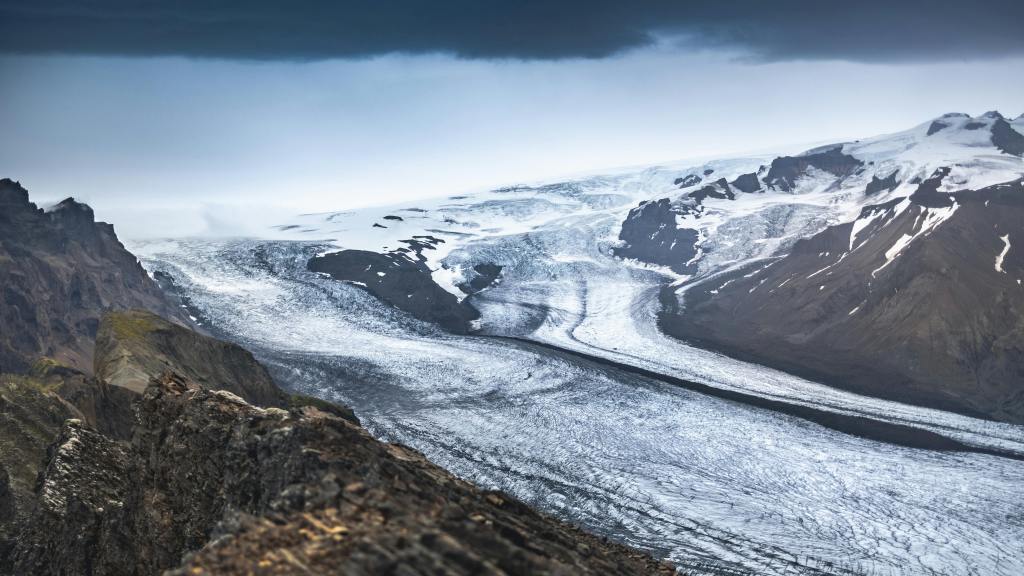
Glaciers in Iceland have been retreating since 1890, and climate change projections suggest that many may disappear within a few hundred years. This retreat alters the balance of forces deep underground. Volcanic systems beneath glaciers are especially sensitive, but even regions outside glacial cover are influenced.
The ISVOLC project was established to answer a central question: How does climate-driven glacier retreat affect volcanic and seismic activity in Iceland?
By combining volcanology and glaciology, ISVOLC seeks to:
- Trace glacier volume changes in Iceland since 1890.
- Understand how these changes affect crustal stress and magma accumulation.
- Assess potential consequences for future eruptions and seismicity.
This framework defines the project’s purpose and long-term goals — to deepen knowledge of Earth processes while informing society about the risks and challenges of a warming world.
Scientific Framework
The approach – how ISVOLC addresses these questions
To explore the links between ice retreat, magmatism, and seismicity, ISVOLC integrates multiple scientific methods and data sources:
- Glacier database – A unified record of Icelandic glacier volume change since 1890-2024 and projected to 2300, derived from field observations and climate modeling. Recent and projected ice mass datasets have high spatial and temporal resolution.
- Observations & remote sensing – Ground levelling observations, GNSS campaign and continuous measurements, InSAR observations, and a relocated earthquake catalogue for areas of interest.
- Geophysical modelling – A new glacial isostatic adjustment (GIA) model for the whole of Iceland from 1890-2300 as well as a suite of new volcano models, incorporating detailed ice history and constrained by extensive geodetic data.
- Mantle melt modeling & ascent forecasts – Model predictions for increases in magma generation in the mantle due to decompression melting as a consequence of deglaciation, and forecasts of the arrival of that new melt at shallow depth.
These datasets and methods allow researchers to investigate critical uncertainties, including:
- If, how, and when new magma may reach the surface.
- How the stability of existing magma reservoirs is affected.
- Whether current deglaciation is already causing larger accumulations of melt.
- How stress-field variations may alter future volcanic and seismic activity.
This framework provides the methodological backbone of ISVOLC, ensuring that its findings rest on a rigorous and multidisciplinary scientific foundation.
 ISVOLC - Effects of climate change induced Ice retreat on Seismic and Volcanic activity